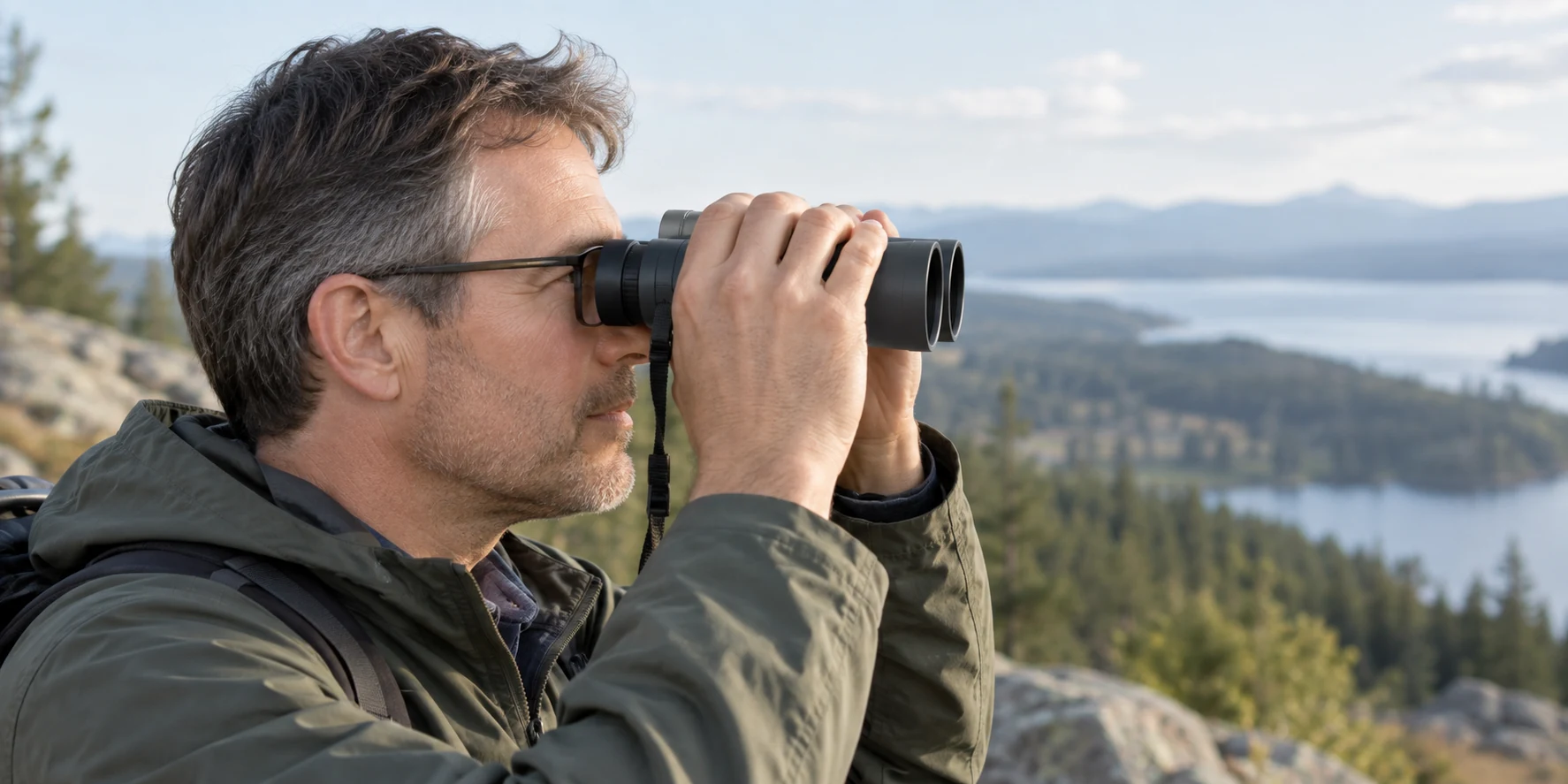
With glasses on, the eyes sit farther behind the eyepieces, which is why long eye relief binoculars matter. When the fit is off, image edges vanish, dark crescents slide into view, or the frames meet the cups. A pair shows a complete field without strain and keeps it stable while focusing. Binocular eye relief starts selection; a test with glasses finishes it.
Start With the Full Field of View
Comfort begins with the visible field. The result comes from the eyepieces, cups, glasses, face, and the way the binocular is held.
Why glasses change eye position
Eye relief is the distance between an eyepiece and the point where the full image forms. Without glasses, an extended eyecup places the eye near that point. Glasses add space and may push the eye too far back when the cup remains raised.
This is why binoculars for glasses wearers usually begin with retracted eyecups. The goal is a natural position that shows one complete circular view without touching lenses or pressing frames into the face.
Eye relief and usable field
Published eye relief is a screening value. Usable eye relief also reflects eyecup shape, lens recess, frame depth, and holding angle. Two people may see different edges because their glasses and faces place their eyes differently.
How much eye relief for glasses is enough? Test the full field against a wall, open sky, or even surface. Relax the head and move slightly closer and farther away. A stable circle with visible edges matters more than a large number that produces dark rings.
Set Eyecups and Diopter in the Right Order
Adjustment should follow a repeatable sequence. Changing several controls at once makes it difficult to know whether a blackout comes from eye distance, barrel spacing, focus, or the difference between the observer’s eyes.
Eyecups in day-to-day use
To adjust binoculars for glasses, start with both eyecups rolled or twisted all the way in. Fold-down cups roll back; twist up eyecups binoculars turn to their lowest stop. If blackouts remain, raise both sides one step. Different frames may require an intermediate position.
Both eyecups should stop at equal heights, resist accidental movement, and feel comfortable against the frames. A loose cup can change in a bag; a sharp rim may meet the glasses before the eye reaches the proper point.
Binocular eyecups for glasses must also leave enough room around the frame, so the bridge and temples remain relaxed during repeated viewing in the field.
Focus and diopter adjustment
Adjust the hinge until both fields merge into one circle. Focus a detailed object for one eye while covering the other side. Then sharpen the second eye with the diopter control. Normal distance changes should then need only the main wheel.
Binocular diopter adjustment with glasses follows the same principle. Corrective lenses may narrow the difference, but check the final setting. If it drifts, ask whether the control locks or resists field movement.
| Test step | Desired result | Common problem |
|---|---|---|
| Retract both eyecups | Full circular field | Tunnel view or frame pressure |
| Set barrel spacing | One merged image | Two circles or dark center |
| Set focus and diopter | Both eyes see equal detail | One side stays soft |
| Scan a moving target | Edges remain easy to use | Blackouts during small movements |
| Repeat after lowering binoculars | View returns quickly | Constant repositioning |
Check Comfort During Real Observation
The best binoculars for glasses wearers should work after the careful setup is finished. A buyer still needs to raise them quickly, hold them naturally, refocus, and keep a moving subject inside the field.
Frame contact and viewing posture
Use the glasses normally worn outdoors, including thick frames or progressive lenses. Hold the binocular naturally for one minute. Notice pressure, eyelashes touching glass, fogging, or head tilt. Small discomfort grows during a long session.
Lower the binocular, turn away, and raise it again five times. Comfortable binoculars for eyeglass wearers should return to a full image without careful placement. A view that requires pressure against the eyecups has a fragile fit.
Bird watching and moving targets
Bird watching binoculars for glasses wearers need forgiving eye placement. A broad binocular field of view with glasses helps when a bird changes direction. Scan branches and follow a moving subject. Watch for dark crescents when the hands shift.
Long eye relief binoculars for bird watching should focus quickly. Move between a nearby branch and distant sign. The wheel should be reachable without disturbing eye position. Best eye relief binoculars for birding combine view, fit, balance, and focus action.
Turn the Fit Test Into Buying Criteria
An organized trial keeps a comfortable showroom view from becoming an awkward field tool. Use one brief routine on every sample and build it around the people who will use the product.
A short in-person test
How to test eye relief binoculars can be reduced to six checks:
- Wear the usual distance or progressive glasses.
- Retract both eyecups and merge the two fields.
- Confirm the entire circular edge on an even background.
- Focus each eye, then scan near and distant targets.
- Follow a moving subject for 30 seconds.
- Lower and raise the binocular five times.
Record full field, blackout, frame contact, focus reach, and recovery as pass or fail. If several users will share the same unit, repeat the routine with different frames. A design that offers useful eyecup stops can suit more faces than one that works at only a single exact position.
Questions for a supplier
For sourcing, ask for eye relief, eyecup type and stops, lens recess, field of view, focus arrangement, diopter range, weight, and sample policy. Request photographs with the cups raised and retracted. These details help shortlist the best binoculars for eyeglass wearers before samples arrive.
The brief should describe the audience and task. How to use binoculars with glasses follows the same principle across travel, events, and nature observation, while holding time, target motion, weather, and carrying needs change the balance.
About Hemusun Optical Instrument Co., Ltd.
At Hemusun Optical Instrument Co., Ltd., the core business covers optical-instrument research, development, manufacturing, and sales. The catalog includes binoculars and monoculars; available services cover OEM, ODM, wholesale, and retail work. Use the eye-relief test, eyecup movement, and viewing routine during sample discussions.
Conclusion
Long eye relief binoculars should show a complete, stable field through the wearer’s real glasses. Start with retracted eyecups, set the barrel spacing, focus both eyes in sequence, and check the diopter. Then raise the binocular repeatedly and follow a moving subject. Published binocular eye relief narrows the list; full-field visibility, low blackout, frame comfort, and easy focus reveal which option works in practice. A short pass-or-fail routine gives both the buyer and supplier a clear basis for discussion.
FAQs
The last questions usually concern eye position, eyecup height, and a quick pre-purchase check.
What are long eye relief binoculars?
The image forms far enough behind the eyepiece for a glasses wearer to reach the complete field. The real fit still changes with cup shape, lens recess, frames, and facial structure.
How much eye relief is useful for glasses?
There is no universal figure for every frame and face. Use the published value to screen options, then verify the full circular field while wearing the glasses used during normal observation.
Should eyecups be up or down when wearing glasses?
Roll or twist both cups inward first. When dark crescents appear, raise each side to the same intermediate stop. The useful position holds a steady field without pushing the frames into the face.
How should binoculars be tested with glasses?
Retract the eyecups, merge the fields, focus both eyes, scan moving and still targets, and raise the binocular repeatedly. Reject a fit that needs constant head movement or loses the field during normal handling.